Each exercise has 3 difficulty levels: novice 🧩, apprentice 🧩🧩, expert 🧩🧩🧩.
You earn a star ⭐ when you complete a level of an exercise.
You can therefore earn up to 3 stars per exercise.
You can generate an automatic summary of your skills at the end of your exercise session
(don't forget to add your first and last name before printing it):
The exercises are also available in print format:
For curious users:
Relationships of common ancestry:
Tree arrangement:
Character distribution:
Playground:
Think you have mastered all 6 exercises above? Take the challenge: get everything right as fast as possible.
Difficulty:
Identify the last common ancestor
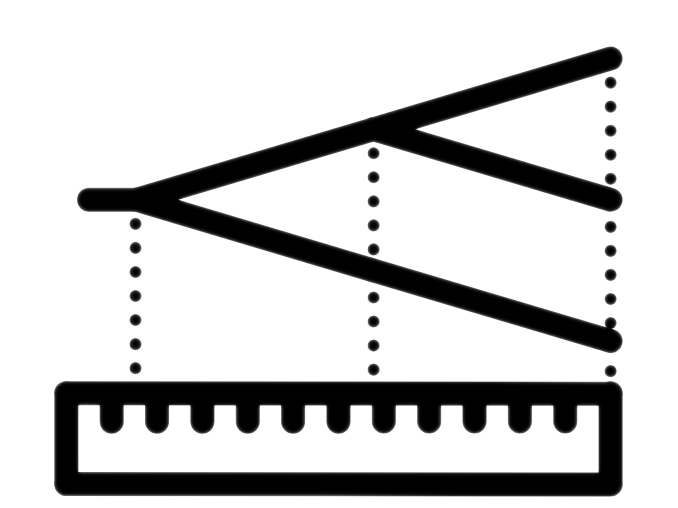
The last common ancestor (or most recent common ancestor) is the most recent ancestor that two species
have in common in the evolutionary tree.
Click on the last common ancestor of and .
00:00
Difficulty:
Determine the closest species
Historical relatedness is a measure of how recent the last common ancestor of two species is.
The more recent this ancestor is, the more historically close the species are considered to be.
Which of or is historically more closely related to ?
00:00
Difficulty:
Find the odd one out among several trees
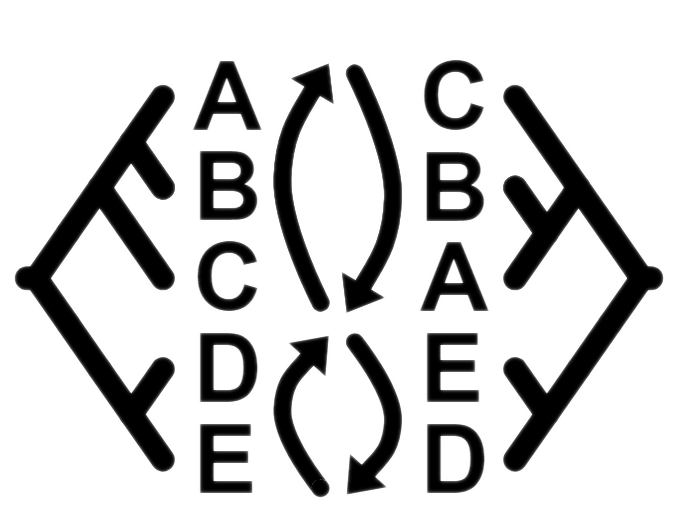
In a phylogenetic tree, the order in which branches coming from the same ancestor are drawn does not matter;
it does not change the relationships of common ancestry between species.
Among the four trees below, three represent exactly the same relationships of common ancestry,
and only one represents different relationships of common ancestry.
Where is the odd one out?
00:00
Difficulty:
Compare tree rootings
If the position of the root is moved in a phylogenetic tree, it no longer represents the same relationships of common ancestry between species.
However, the structure of the tree remains the same.
The root has been moved in the four trees below. Three of these trees have not undergone any other modification and therefore keep the same structure,
whereas only one has undergone an additional modification and therefore has a different structure.
Compare the structures of these trees and find the one that does not have the same structure as the others.
00:00
Difficulty:
Locate evolutionary transformations
Use the character distribution in the matrix below to infer on which branch of this phylogenetic tree it changed (appearance or disappearance).
Left-click on a branch to place the transformation.
00:00
Legend:
Absent
Present
Difficulty:
Match a tree to the matrix
Given a character matrix, some trees require fewer character transformations to explain the observed distribution.
This is the principle of parsimony: the simplest explanation is the best one.
Compare the matrix below with the four proposed trees and select the most parsimonious one.
00:00
Legend:
Absent
Present
Explore the database freely
Select the species and characters you are interested in after choosing a dataset.
Datasets:
Species (max. ):
Characters:
Legend:
Absent
Present
Inapplicable
Unknown
Information
Unambiguous transformations: .
ACCTRAN: .
DELTRAN: .
Create printable exercise worksheets
Choose a number between 0 and 20 for each combination of exercise type and difficulty level.
Then click the button to randomly generate the corresponding exercises.
The worksheet containing the exercises is then created and downloaded automatically.